Sharing Economy Services Shake Up Corporate Travel
One of our partners and provider of cloud-based travel and expense management software, Certify, today announced the results of its third annual SpendSmart™ report for the fourth quarter and full year 2015. The report found that for the first time, ride-hailing giant Uber overcame car rental as a percent of total national ground transportation in Q4. Prior to the fourth quarter, only San Francisco and Boston reported Uber as having a greater percent of rides than car rental.
The face of corporate travel has changed dramatically in the past decade, and the pace of change is picking up speed as disruptive sharing economy services like Uber grow in popularity. Last year we wrote about Uber beating out taxis as the preferred mode of transport for corporate travelers, but this latest report is the first to reveal just how hard the service (and others like it, including Lyft) has hit the rental car market. But Bob Neveu, CEO of Certify, doesn’t think rental cars are ever going to replaced completely by ride-hailing services. “There’s always going to be a need for that marketplace when you have to drive longer distances, further away,” he told NPR.
But it’s clear that traveling employees are quick to embrace travel booking apps that cut out some of the planning and back-and-forth involved in booking a service ahead of time from a traditional vendor. Services like Uber, Lyft, Airbnb, and HotelTonight allow corporate travelers much more freedom to adjust their schedules on the fly. It’s likely that car rental companies will begin to step up their offerings in terms of mobile features and the ability to make last-minute reservations.
Corporate travelers are especially receptive to mobile-friendly start-up technology with a high convenience factor, and this is what makes this area of B2B payments software so innovative. Many travel and expense management (TEM) software solutions have already directly integrated with Uber and Airbnb, or they allow users to email receipts directly to their expense report. With this connection, employees don’t have to deal with booking companies, reservation fees, and the miscommunication that can come through multiple channels of travel arrangement.
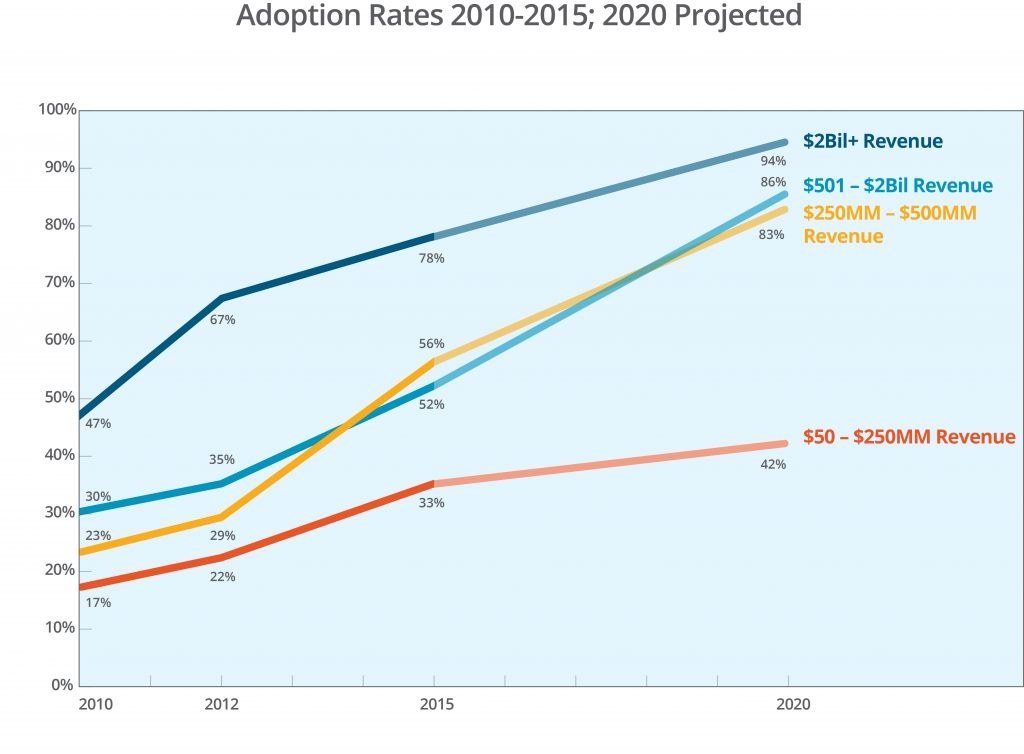
Our own research reveals massive growth in the TEM software market as these cloud-based solutions lower prices and add new mobile functionalities, see below. Adoption rates range from 78% in enterprise organizations to 35% in lower middle market organizations. PayStream projects that by 2020, the TEM market will surpass $2.1 billion and enterprise organizations will achieve near full adoption. The majority of this growth will come from the SME market, having a 14% CAGR and going from $167 million total revenues in 2015 to $342 million total revenues in 2020.
For more information on the capabilities of today’s TEM solutions and how they work for organizations of various sizes, download the full Travel and Expense Management Navigator.
Rate this Post:Blog Feed
-
 5 Questions to Ask Intern... This post was contributed by Deepesh Jethwani, Consulta...
-
 Coupa Announces Launch of... Several of our team members here at PayStream attended ...
-
 Key Takeaways from the La... Very few companies have a fully automated Source-to-Set...